
Why Walkability Matters
How walkability influences quality of life, neighborhood identity, and long-term value in Miami.
When people think about what makes a neighborhood desirable, they often focus on factors such as location, architecture, schools, or access to amenities.
Yet one of the characteristics that quietly influences how people experience a place every day is often much simpler: walkability.
Walkability refers to how easily residents can reach everyday destinations on foot. Restaurants, parks, local businesses, schools, services, and public spaces all contribute to creating neighborhoods where daily life can happen without constantly relying on a car.
While the concept may seem straightforward, its impact extends far beyond convenience.
More Than Getting From One Place to Another
Walkability influences how people interact with their surroundings.
In walkable neighborhoods, residents are more likely to encounter local businesses, spend time in public spaces, and engage with the community around them. Streets become more than transportation corridors; they become part of everyday life.
Urban planners, developers, and researchers have increasingly recognized walkability as an important component of neighborhood quality, influencing everything from mobility patterns to economic activity and public space activation.
As cities continue to grow, creating environments that support daily life within a comfortable walking distance is becoming an increasingly important consideration.
The Growing Importance of Walkable Neighborhoods
Across the United States, demand for walkable urban environments has increased as residents seek neighborhoods that offer convenience, accessibility, and a stronger sense of place.
At the same time, transportation costs, commuting times, and changing lifestyle preferences have encouraged many people to prioritize locations where essential destinations are within easy reach.
For businesses, walkable areas often create opportunities for stronger foot traffic and a more active street environment. For residents, they can reduce dependence on driving while creating a more connected experience of the neighborhood.
The result is a growing recognition that the quality of everyday life is shaped not only by individual buildings but also by how those buildings connect to the larger urban environment.
Walkability in Miami
Miami has traditionally been viewed as a car-oriented city. However, several neighborhoods have demonstrated how walkability can contribute to a distinct urban experience.
Areas such as Brickell, Downtown Miami, Wynwood, Coral Gables, and Coconut Grove are often recognized for offering a greater degree of pedestrian accessibility compared to many suburban parts of South Florida.
What makes Coconut Grove particularly interesting is that walkability is closely tied to its identity.
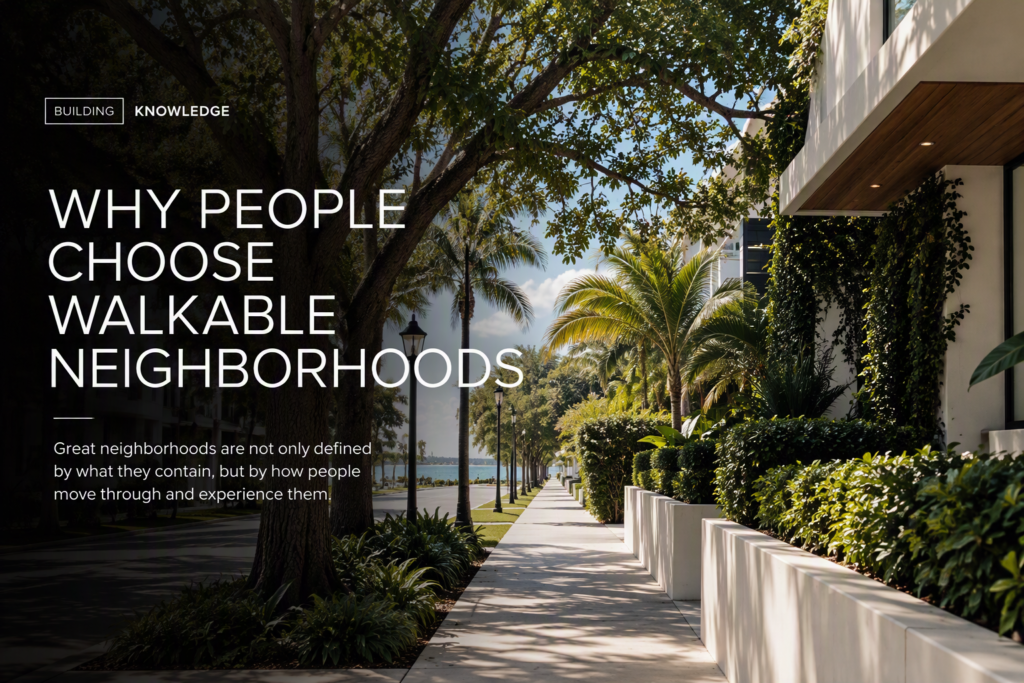
Unlike many neighborhoods that were primarily built around the automobile, the Grove developed with a village-like character that still influences how residents experience the area today. Its mix of residential streets, local businesses, waterfront parks, and public spaces creates an environment where many daily activities can happen within a short walk.
Walk through Coconut Grove on any given day and you’ll find residents heading to local cafés, parks, marinas, shops, and restaurants without needing to get in their cars. The neighborhood demonstrates how walkability can help create a stronger connection between people and place.
Why It Matters for Real Estate
Walkability is not simply an urban planning concept.
It can influence how people evaluate where they want to live, work, and spend time.
Neighborhoods that offer access to services, recreation, and community destinations within walking distance often create a different experience than places where every activity requires a car trip.
For developers, investors, and property owners, understanding these dynamics is important because long-term value is shaped by more than a single building. It is also shaped by the quality of the neighborhood around it, the accessibility of daily destinations, and the way people interact with the environment over time.
As Miami continues to evolve, factors such as connectivity, public space, neighborhood character, and walkability will likely play an increasingly visible role in how communities grow and how people choose where to live.
The Saxum Perspective
At Saxum, we believe great neighborhoods are not defined solely by what they contain.
They are defined by how people experience them.
Walkability is not simply a feature or an amenity. It is part of a broader urban ecosystem that influences quality of life, neighborhood identity, and long-term value creation.
Understanding these dynamics is an important part of understanding real estate itself.
Because great places are not only destinations.
They are places people experience every day.